AI in cross stitch
AI is showing up in practically every creative field, and cross stitch is no exception. But "AI in cross stitch" can mean a variety of different things, and I want to try to clear up some of the misconceptions.
Before jumping in, it's worth remembering that AI is developing quickly. By the time you read this, some aspects of the technology, its capabilities, or the discussions surrounding it may have changed.
Let’s first define “AI”
These days, most people are talking about generative AI technology that can generate text, images, code, music, or other material from prompts. Large language models (LLMs) are a type of generative AI that can write, summarize, explain, brainstorm, and answer questions because they have been trained with large amounts of text. Another type is image generators, which are trained on images to then create new images from text prompts, reference images, or a combination of the two.
It is also worth noting that not every automated feature is considered AI. Cross stitch software has used image processing, color matching, and chart generation technology for decades. Whether those tools should be considered "AI" depends on how broadly the term is being used, as “AI” can be used as an umbrella term that includes both generative tools and traditional automation tools built on complex algorithms, which is part of what makes this topic so complex.
How AI is usually used in cross stitch
It’s important to note that most cross stitch designers still use traditional methods when creating their designs, but for those designers who do use AI in their process, image generators are the most commonly used technology to create designs and artwork. A designer may use an AI image generator to create an illustration, a digital painting, or even a mood board with color suggestions. AI image generators are also increasingly being used to make aesthetic previews, such as mockups that show a design against a pretty backdrop and give the impression that it has already been stitched.
Most designers who use AI still rely on traditional charting software to convert artwork into stitchable patterns.
There are already well established tools for transforming original artwork or photographs into charts. These tools can intelligently reduce colors, map to specific floss color palettes, calculate stitch counts, and export high quality charts and previews. Because this workflow is already effective, most designers continue to rely on traditional charting software rather than generative AI to create patterns. It is still worth being aware that there are some generative AI tools that will attempt to generate a whole cross stitch pattern from start to finish, including design, chart, colors, and occasionally even a stitched-looking preview. However, at least for now, this represents a smaller portion of how AI is used, and generally results in poor quality charts that can be challenging to work from.
Common concerns regarding AI in cross stitch
Ethics of AI generated images
When AI generates the image a pattern is based on, the questions get more challenging. Many stitchers and artists are opposed to AI-generated pattern artwork because some image models have been trained on copyrighted or publicly available works without explicit permission. This has led to ongoing both legal and ethical debates, not just in the cross stitch community, but in creative spaces at large. Copyright law surrounding AI-generated images is still developing in many countries, and questions about ownership, licensing, and the legal status of AI-generated artwork continue to be debated.
Inaccurate previews
Another concern is the accuracy of AI-generated previews. They can appear polished and real, but it may not accurately reflect the actual stitched product. A preview may show unrealistic detail, blended shading that does not correspond to real floss colors, flawless lighting, or texture that has nothing to do with actual thread on fabric. An accurate preview is important for stitchers when deciding to purchase a pattern. A preview should help us understand what we're buying, not make the end work appear better than the chart can reasonably produce.
However, this does not imply that all digital mockups are AI generated; even before generative AI, digital mockups could be exported directly from charting software, which is still a popular method to showcase cross stitch patterns. These mockups are generally accurate, however it can be challenging to identify the differences between a mockup from a pattern software, from an image generated model, or one made from a combination of these alongside photo editing and/or real world sample photographs.
Environmental impact
Environmental concerns are also a major topic in discussions about AI in cross stitch, and AI in general. AI systems can require significant computing resources, energy, and water to train and operate. The scale of this impact varies depending on the specific system and how it is used, but for some stitchers and designers it remains an important consideration.
Pattern mills
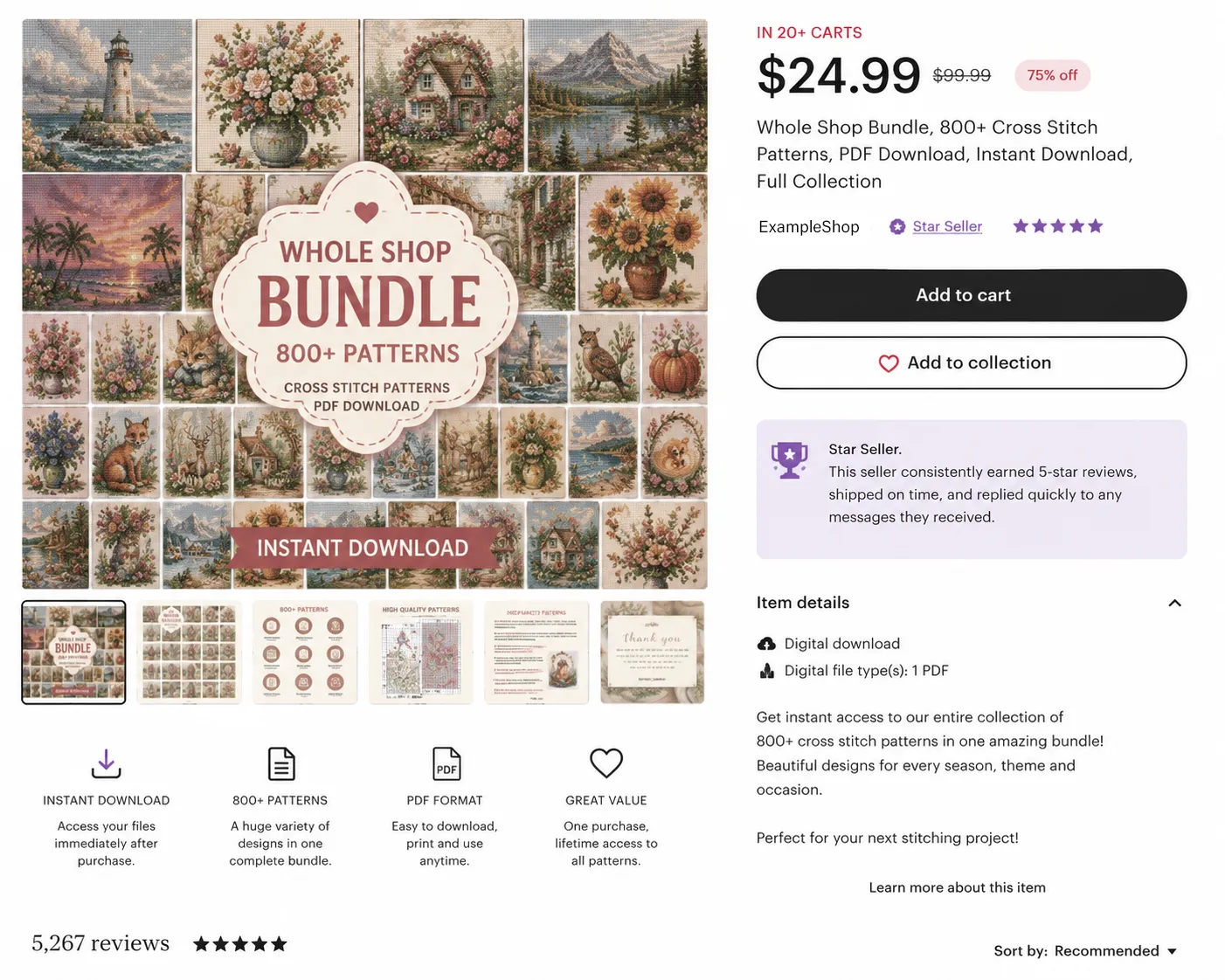
The term pattern mill often comes up in discussions about AI in cross stitch, although pattern mills existed before generative AI became widely available. A pattern mill is usually a shop run by a company or an individual that produces large numbers of cross stitch patterns with little or no quality control. These patterns are often created by converting images into charts, either using traditional charting software or AI, rather than carefully editing and refining them for stitching.
Pattern mills existed before generative AI. AI has made it easier for some sellers to produce designs at scale, but it did not create the practice.
Not all pattern mills use AI, but many now use AI-generated artwork as the basis for their patterns. And because AI can produce a large number of images quickly, it has made it easier for some sellers to create and list hundreds or even thousands of patterns in a short period of time, usually at a very low price. Though low price and a large catalogue does not automatically mean a shop is a pattern mill, and using AI does not automatically make a designer a pattern mill. What generally distinguishes a pattern mill is the emphasis on producing patterns at scale with little evidence of testing, refinement, or quality control.
Is all AI bad?
AI can be useful for designers for brainstorming, drafting product descriptions, or creating marketing plans. Some stitchers even use it to help recommend color conversions. AI-assisted tools can help generate charts from source images that are original or appropriately licensed, and perhaps in the future, AI tools will be able to perform this task better than existing programs.
Whether AI is something you wish to use or avoid is ultimately a personal decision. Taking a stance that you want to avoid stitching a pattern where the designer has used AI, either to generate the artwork, create a mockup, or help write product descriptions, is completely fair and entirely up to you.
This technology is changing quickly, and as we learn more about how it is built, how it is used, and what impact it has, our opinions may continue to change, and that’s ok.
Log in to react.